
01 / Research question
How much should a bullish copper forecast change a long-lived investment decision?
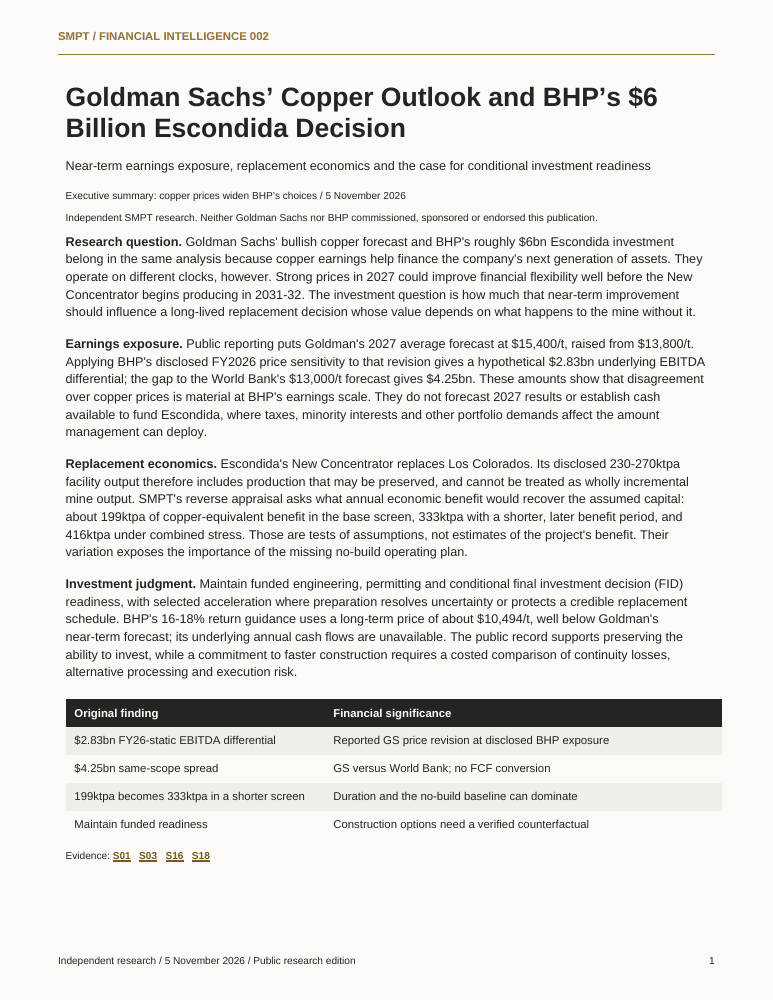
Goldman Sachs’ copper outlook makes a material difference at BHP’s earnings scale. Escondida’s investment case turns on a different question: what production and cash flow would the mine lose without a new concentrator?
The two decisions run on different clocks. Higher copper prices in 2027 could expand financial flexibility before a replacement plant starts producing in 2031–32. SMPT connects those horizons without treating a near-term forecast as a long-term project price, or earnings sensitivity as investment cash.
FY2026-static underlying EBITDA differential from the reported Goldman forecast revision.
Maintain engineering and permitting progress; test major construction commitments against costed alternatives.
02 / Copper-price exposure
The forecast gap is material. Translating it into financing requires more evidence.
Public reporting attributes a $15,400/t calendar-2027 average to Goldman Sachs, raised from $13,800/t. The World Bank’s October outlook puts the same year’s average at $13,000/t. Applying BHP’s disclosed $39 million EBITDA sensitivity per US cent/lb gives $2.83 billion for Goldman’s revision and $4.25 billion for the Goldman–World Bank gap.
Three price expectations, one calendar year
US dollars per tonne · calendar-2027 annual average
$1,600/t price difference
$2,400/t price difference
Sources: FinancialJuice, 20 October 2026; World Bank, October 2026, Table 1; BHP FY2026 presentation, slide 48. SMPT calculations. The original Goldman note was not obtained; public reporting provides the annual average. Goldman’s separate $15,600/t end-2027 view has a different horizon.
These are hypothetical sensitivities holding BHP’s FY2026 exposure static. They exclude a forecast of volume, costs, taxes and distributions. Escondida is 57.5% economically owned but fully consolidated; applying a uniform ownership percentage to reported Group exposure would misstate its accounting scope. Neither differential represents forward earnings or cash available for the project.
03 / Replacement economics
Preserved production matters more than the plant’s headline output.
The New Concentrator replaces Los Colorados. BHP’s $5.4–6.3 billion gross capital estimate and 230–270 ktpa facility-output range describe the planned asset; they do not establish its incremental benefit to the mine. A with-build/no-build comparison must include production preserved, alternative processing, avoided costs and relevant capital.
SMPT reverses the appraisal: given assumed spending and an assumed margin, what level annual benefit would recover capital? The result changes substantially with benefit duration and timing. Comparing the screens below shows why 199 ktpa cannot settle the investment decision.
What must the replacement investment preserve or add?
Required production-equivalent benefit, rather than total facility output
Required production-equivalent benefit
199 ktpa
Twenty assumed benefit years spread the recovery of capital over a long operating period. The public record does not establish twenty years of flat incremental benefit.
- Gross capital
- $5.85bn
- Long-term copper
- $10,494/t
- Benefit period
- 20 years · 2032–51
- Annual after-tax benefit
- $839m
All four tests and common assumptions
| Assumption test | Benefit period | Required ktpa |
|---|---|---|
| Base | 20 years · 2032–51 | 199 |
| Shorter benefits | 10 years · 2032–41 | 275 |
| Shorter, later | 10 years · 2034–43 | 333 |
| Combined stress | 20 years · 2034–53 | 416 |
End-2026 valuation origin; 10% nominal discount rate; five equal year-end capital draws in 2027–31; $4,000/t all-in net burden; 35% assumed cash-tax wedge. Price and contribution stay flat in nominal dollars. No ramp-up or terminal value. The workbook includes six selectable scenarios and additional sensitivities; these four tests explain duration, timing and combined stress.
Source: SMPT reverse appraisal, published sensitivity calculations (CSV). Equivalent benefit includes output preserved or added against no build. These are assumption-dependent capital-recovery screens, not independently established project viability thresholds.
BHP’s management-guided 16–18% return uses a long-term copper assumption of approximately $10,494/t, below Goldman’s near-term forecast. The underlying annual project cash flows and no-build mine plan are unavailable. SMPT’s screen does not reproduce that IRR or independently value the project.
Project estimates: BHP FY2026 results presentation, slides 19–22 and 35–36. All capital and equivalent-benefit screens above use a gross project basis. Applying the same 57.5% ownership factor to both sides cancels in the ratio.
04 / Capital allocation
Maintain funded readiness. Make construction timing earn its place.
BHP’s October operating review records $0.8 billion of gross pre-commitment funding approved for engineering, permitting and execution readiness. Approval is distinct from spending already incurred or a final construction sanction. The research supports maintaining that preparation and selectively accelerating work that resolves uncertainty or protects a credible replacement schedule.
Acceleration requires
Discounted avoided continuity losses that exceed the acceleration premium and execution risk, with permits and a feasible schedule.
Staging or deferral requires
A credible interim operating plan whose retained flexibility outweighs deterioration, escalation and lost operating benefit.
The decision changes with
A costed no-build mine plan, annual production and fiscal schedules, binding execution alternatives and material permitting conditions.
Stronger copper prices expand the choices available to management. They do not rank Escondida against other uses of capital. Historical cash flow, cumulative management projections and gross project budgets have different scopes; subtracting project capital twice or equating EBITDA with deployable cash would create an artificial funding conclusion.
Readiness source: BHP quarterly operating review, 20 October 2026, pp. 1–2. The indexed Chilean permitting file showed evaluation pending at the research cutoff, including a 4 November applicant request. The mirror and document-access limits do not support a delay probability or approval-date forecast.